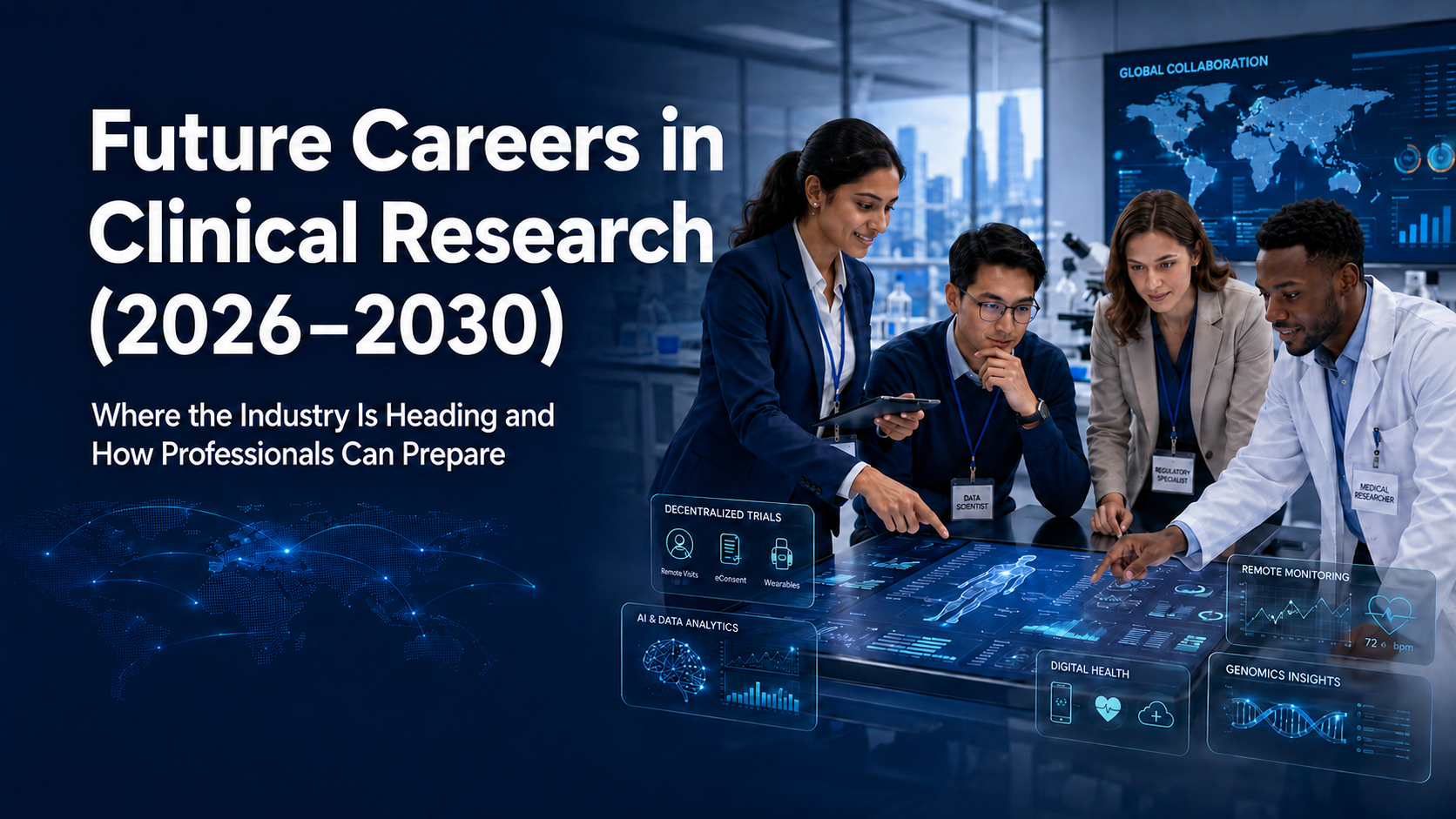
For professionals considering a career in clinical research-or those already working in the industry-the next five years present exciting opportunities to develop new skills, explore emerging roles, and contribute to innovations that have the potential to improve healthcare globally.
The question is no longer "Is clinical research a good career?" but rather "How can professionals prepare for the future of clinical research?"
Why Clinical Research Will Continue to Grow
Several global trends are driving demand for clinical research professionals:
- Increasing investment in biotechnology and pharmaceutical innovation
- Growth of precision and personalised medicine
- Expansion of cell and gene therapies
- Rising number of medical device and digital health studies
- Greater emphasis on real-world evidence
- Increasing use of decentralised and hybrid clinical trials
- Growing global collaboration across research organisations
As new therapies become more complex, organisations require multidisciplinary teams with scientific, operational, regulatory, and technological expertise.
Emerging Career Opportunities (2026–2030)
The future of clinical research extends far beyond traditional site-based roles.
Some of the fastest-growing career paths include:
Clinical Trial Project Management
Modern clinical trials involve multiple countries, vendors, technologies, and stakeholders.
Project Managers are increasingly responsible for:
- Study planning
- Risk management
- Vendor oversight
- Budget control
- Timeline management
- Cross-functional leadership
Strong organisational and communication skills will become even more valuable.
Regulatory Affairs
As regulatory expectations continue to evolve globally, demand for professionals who understand submission strategies, compliance requirements, and international regulations will continue to grow.
Future opportunities include:
- Global regulatory strategy
- Electronic submissions
- Regulatory intelligence
- Medical device regulations
- Post-marketing compliance
Medical Writing
Scientific communication remains central to drug development.
Medical Writers contribute to:
- Clinical Study Protocols
- Investigator's Brochures
- Clinical Study Reports
- Regulatory submissions
- Publications
- Risk Management documentation
With increasing global clinical development, demand for experienced medical writers is expected to remain strong.
Clinical Data Management
Clinical trials generate enormous volumes of data.
Professionals skilled in:
- Electronic Data Capture (EDC)
- Data validation
- Data review
- Query management
- Data governance
will continue to play a critical role in ensuring data quality and regulatory compliance.
Biostatistics and Statistical Programming
Clinical decisions depend on reliable statistical analysis.
Professionals experienced in:
- Biostatistics
- SAS Programming
- R Programming
- CDISC standards
- Statistical analysis planning
will remain essential throughout the drug development process.
Pharmacovigilance and Drug Safety
Patient safety remains at the centre of clinical development.
Future opportunities include:
- Signal detection
- Benefit-risk evaluation
- Risk management planning
- Aggregate safety reporting
- Post-marketing surveillance
As medicines become more advanced, pharmacovigilance expertise will become increasingly important.
Clinical Operations
Clinical Operations professionals ensure that studies are executed efficiently while maintaining quality and regulatory compliance.
Future roles will increasingly involve:
- Remote monitoring
- Risk-based monitoring
- Vendor management
- Site relationship management
- Operational strategy
Artificial Intelligence and Digital Clinical Trials
Artificial intelligence is already supporting several aspects of clinical research, including:
- Patient recruitment support
- Risk identification
- Data review
- Operational analytics
- Document drafting assistance
- Workflow automation
While AI will improve efficiency, it is expected to support—not replace—clinical research professionals. Human expertise will remain essential for scientific judgement, ethics, patient safety, and regulatory decision-making.
Professionals who understand how to work effectively alongside AI-enabled tools are likely to be well positioned for future opportunities.
Skills That Will Matter Most
Technical knowledge alone will no longer be enough.
The professionals who thrive between 2026 and 2030 are likely to combine scientific expertise with transferable skills such as:
- Critical thinking
- Project management
- Scientific communication
- Regulatory knowledge
- Data interpretation
- Problem-solving
- Digital literacy
- Cross-functional collaboration
- Leadership
- Adaptability
Continuous learning will become an important part of every successful clinical research career.
A Truly Global Career
One of the greatest strengths of clinical research is its international nature.
Professionals increasingly have opportunities to collaborate across:
- Pharmaceutical companies
- Biotechnology organisations
- CROs
- Medical device companies
- Academic research institutions
- Digital health organisations
- Global consulting teams
Many roles can now be performed remotely or through international collaboration, allowing professionals to contribute to global clinical development programmes from different parts of the world.
Preparing for the Future
Whether you are a medical graduate, pharmacist, dentist, nurse, life sciences graduate, biotechnology professional, statistician, or someone looking to transition into clinical research, building practical, industry-relevant skills is essential.
Developing expertise in areas such as regulatory affairs, medical writing, clinical operations, project management, pharmacovigilance, clinical data management, and biostatistics can broaden career opportunities and prepare professionals for the evolving demands of the industry.
Beyond technical knowledge, staying curious, embracing new technologies, and committing to continuous professional development will be key to long-term success.
Final Thoughts
Clinical research is more than a career-it is an opportunity to contribute to scientific innovation and improve patient care worldwide.
As we move towards 2030, organisations will increasingly value professionals who combine scientific understanding with operational excellence, regulatory awareness, effective communication, and collaborative leadership.
At Agile Clinical Trendz, we believe the future of clinical research belongs to professionals who are prepared to learn continuously, adapt to change, and apply their knowledge in real-world settings. Our commitment is to support the development of industry-ready talent through practical learning, mentorship, and multidisciplinary exposure that reflects the evolving needs of the global clinical research landscape.
How do you see clinical research evolving over the next five years? Which emerging skill or career path excites you the most? Share your thoughts in the comments-we'd love to hear your perspective.