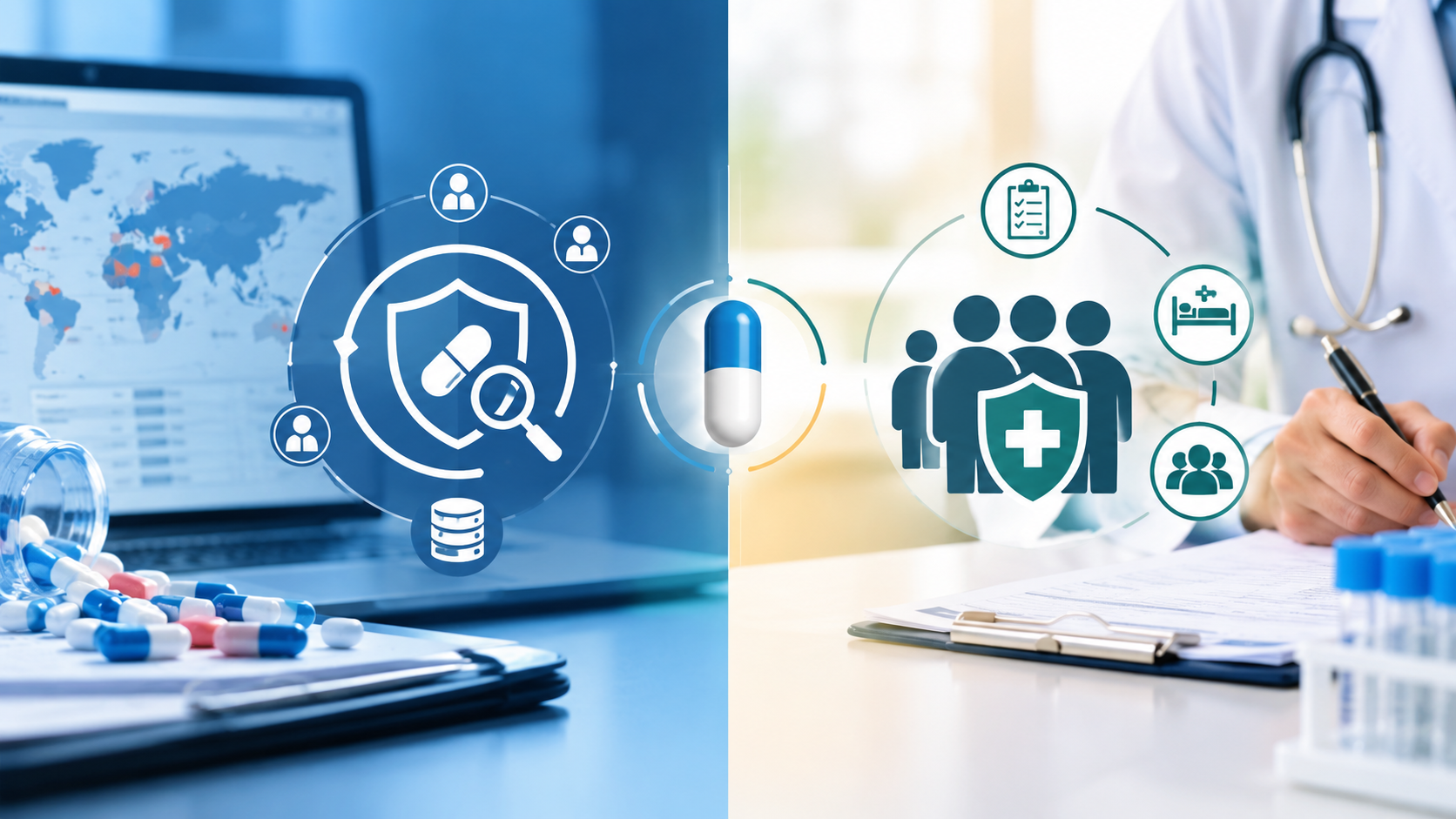
In clinical research, pharmacovigilance and clinical safety are closely connected.
So closely,
in fact, that the terms are sometimes used as though they mean exactly the same
thing.
They do
not.
Both
ultimately contribute to the same fundamental objective:
Protecting
participants and patients by understanding and managing the risks associated
with medicines.
But they
differ in scope, timing, data sources and operational responsibilities.
For
sponsors, CROs, investigators and clinical research professionals,
understanding this distinction is more than terminology.
It affects how safety teams are structured, how responsibilities are assigned, how information flows across a development programme and how emerging risks are identified and managed.
Start With
the Bigger Concept: What Is Pharmacovigilance?
The World
Health Organization defines pharmacovigilance as the science and activities
relating to the detection, assessment, understanding and prevention of
adverse effects or other medicine-related problems.
This
definition immediately tells us something important:
Pharmacovigilance
is not simply adverse-event reporting.
It is a medicine-lifecycle
discipline.
It may
encompass safety information arising during:
Pre-authorisation
clinical development
↓
Regulatory
review
↓
Post-authorisation
use
↓
Long-term
surveillance
The objective is to understand how the safety profile of a medicinal product evolves as exposure increases and new information becomes available.
What Do We
Mean by Clinical Safety?
In drug
development, clinical safety generally refers to the activities used to
collect, assess, monitor and interpret safety information arising during
clinical development.
That can
include:
- Adverse Events (AEs)
- Serious Adverse Events (SAEs)
- Suspected adverse reactions
- SUSARs
- Laboratory abnormalities
- Vital-sign abnormalities
- ECG findings
- Physical examination findings
- Adverse Events of Special Interest (AESIs)
- Dose-limiting toxicities
- Pregnancy information
- Safety endpoints
- Deaths and discontinuations
- Other clinically relevant safety observations
Clinical
safety therefore focuses heavily on answering:
“What are
we learning about the safety of this investigational product in the
participants exposed during clinical development?”
Pharmacovigilance asks that question too-but across a broader product lifecycle.
The
Simplest Way to Understand the Difference
A useful
conceptual distinction is:
Clinical
Safety
Safety
surveillance within clinical development.
Pharmacovigilance
The broader
system for understanding and managing medicinal-product safety across
development and post-authorisation use.
There is
substantial overlap.
Clinical
safety can therefore be considered an important component of the broader
pharmacovigilance framework.
But
organizational terminology varies between companies, so the exact boundaries of
departments labelled “Clinical Safety,” “Drug Safety” or “Pharmacovigilance”
are not universally standardized.
That is why responsibilities should be defined explicitly rather than assumed from job titles.
Consider a
Medicine Across Its Lifecycle
Imagine an
investigational medicine entering first-in-human development.
During
early clinical trials, safety teams may examine:
- Initial tolerability
- Dose-related toxicity
- Laboratory changes
- Serious events
- Potential target-organ toxicity
As
development progresses, exposure increases.
The safety
questions evolve.
Phase II
and III programmes may examine:
- Larger safety datasets
- Adverse-event patterns
- Events of special interest
- Treatment discontinuations
- Comparator differences
- Subgroup effects
- Cumulative safety experience
After
authorization, the medicine may be used by thousands-or millions-of patients.
Now
additional evidence may emerge from:
- Spontaneous adverse-reaction reports
- Real-world healthcare databases
- Registries
- Scientific literature
- Post-authorisation studies
- Other regulatory authorities
- Medication-error reports
- Special populations
- Long-term exposure
The safety
function therefore evolves from:
Clinical-trial
safety surveillance
into
Lifecycle pharmacovigilance.
Clinical
Safety Begins With the Participant
During a
clinical trial, the investigative site is often the first point at which new
safety information becomes visible.
A
participant develops a medical event.
The
investigator assesses it.
Depending
on the event and applicable requirements, information may then move through a
pathway such as:
Participant
↓
Investigator
/ Site
↓
Sponsor or
CRO Safety Team
↓
Safety
Database
↓
Medical
Review
↓
Regulatory
Assessment
↓
Required
Reporting
↓
Cumulative
Safety Evaluation
This
process requires close interaction between:
- Investigators
- CRCs
- CRAs
- Project teams
- Medical monitors
- Safety physicians
- Pharmacovigilance specialists
- Data managers
- Regulatory teams
Clinical safety is therefore inherently cross-functional.
AE, SAE and
SUSAR Are Not Interchangeable
Understanding
the terminology is fundamental.
Adverse
Event — AE
An adverse
event is an untoward medical occurrence associated temporally with use of a
medicinal product, without necessarily implying causation.
Therefore:
AE ≠
adverse reaction
An event may occur while a participant is receiving treatment without being caused by that treatment.
Serious
Adverse Event — SAE
Seriousness
relates to regulatory outcome criteria.
An event
may be considered serious when, for example, it:
- Results in death
- Is life-threatening
- Requires or prolongs inpatient hospitalization
- Results in significant disability/incapacity
- Results in congenital anomaly/birth defect
Other
medically important events may also meet seriousness criteria depending on the
circumstances.
Importantly:
Seriousness
≠ severity.
A severe event is not automatically serious in the regulatory sense.
SUSAR
A Suspected
Unexpected Serious Adverse Reaction combines three important assessments:
- Serious
- Suspected causal relationship
- Unexpected
SUSARs may
trigger expedited regulatory reporting according to applicable jurisdictional
requirements.
ICH E2A provides internationally harmonized definitions and standards for expedited reporting during clinical development.
Case
Processing Is Only One Part of Safety
A
pharmacovigilance operation may process thousands of Individual Case Safety
Reports.
Each case
may involve:
Receipt →
Triage → Data Entry → Coding → Medical Assessment → Expectedness → Causality →
Quality Control → Submission → Follow-up
These
activities are essential.
But a
compliant case-processing system alone does not constitute mature
pharmacovigilance.
Why?
Because an
individual case tells us what happened to one person.
Safety
science also needs to ask:
What do all the cases tell us together?
Aggregate
Safety Assessment Changes the Perspective
Imagine
five serious cardiac events occurring across a global development programme.
Individually,
none may establish causality.
But when
reviewed together, important questions emerge:
- Are the events occurring more frequently than
expected?
- Are they concentrated in one treatment arm?
- Is there a temporal relationship with exposure?
- Is there a dose relationship?
- Are particular patients at greater risk?
- Is there biological plausibility?
- Are similar findings appearing in other studies?
FDA's
current IND safety-reporting framework specifically emphasizes sponsor
evaluation of safety information and recognizes situations in which aggregate
analysis is necessary to determine whether evidence suggests a causal
relationship.
This is where pharmacovigilance moves beyond individual case management into safety science.
Signal
Detection: Looking for the Pattern
A safety
signal is information suggesting a new potentially causal association—or a new
aspect of a known association—that warrants further investigation.
Signals may
arise from:
- Individual cases
- Clusters of cases
- Clinical trials
- Laboratory trends
- Scientific literature
- Nonclinical findings
- Real-world data
- Spontaneous reporting systems
- Other regulatory information
The crucial
word is:
Signal.
A signal is
not automatically proof of causality.
It is
information that requires evaluation.
Signal
management may involve:
Detection
↓
Validation
↓
Prioritization
↓
Assessment
↓
Recommendation
↓
Risk-management
action where appropriate
This illustrates why pharmacovigilance requires medical, epidemiological and scientific judgment—not merely database management.
Where Does
the Medical Monitor Fit?
Another
source of confusion is the relationship between pharmacovigilance and medical
monitoring.
The medical
monitor may support:
- Clinical interpretation of adverse events
- Protocol-related medical questions
- Eligibility questions
- Review of laboratory abnormalities
- Emerging medical issues
- Safety trend assessment
- Investigator communication
- Escalation of safety concerns
The
PV/safety organization may manage:
- Safety case processing
- Regulatory reporting
- Safety database activities
- Aggregate safety review
- Signal-management processes
- Safety documentation
The
functions overlap, but they are not necessarily identical.
The exact
operating model varies between sponsors and CROs.
The
important requirement is not what the departments are called.
It is that responsibilities, interfaces and escalation pathways are clearly defined.
Clinical
Database vs Safety Database
Another
important distinction exists at the system level.
Clinical
trial information may be captured in the:
EDC system
while SAE
information may also be captured in the:
Safety
database
This
creates two related records of the same event.
For
example:
EDC
Participant 004
Hospitalization
Onset: 12 March
Safety Database
Participant 004
Serious adverse event
Onset: 13 March
Now there is a discrepancy.
Which date
is correct?
This is why
SAE reconciliation is important.
Clinical
data management and safety teams need processes to identify and resolve
inconsistencies between clinical and safety systems.
Safety cannot operate as an isolated department.
Expectedness
Is Not the Same as Predictability
Expectedness
is assessed against the applicable reference safety information.
During
clinical development, that may involve the Investigator's Brochure and defined
Reference Safety Information.
A reaction
is not “expected” simply because a physician thinks:
“This could
happen with this type of drug.”
The
assessment must follow the applicable reference information and regulatory
framework.
This distinction directly affects expedited reporting.
Safety
Reporting Is Jurisdiction-Specific
Global
pharmacovigilance becomes particularly complex because safety-reporting
requirements are not identical everywhere.
Under the
U.S. IND framework, sponsors must notify FDA and participating investigators of
qualifying potential serious risks within applicable reporting timelines. FDA's
December 2025 final sponsor guidance also addresses safety surveillance plans,
aggregate analysis and other aspects of IND safety assessment.
European
clinical trials operate under the EU Clinical Trials Regulation and associated
safety-reporting requirements.
Other
countries may impose additional national requirements.
A global
safety operation therefore needs:
A harmonized core process + jurisdiction-specific regulatory intelligence.
Pharmacovigilance
Continues After Approval
This is
where the difference becomes particularly clear.
The
clinical trial eventually ends.
Pharmacovigilance
does not.
Once a
medicine reaches routine clinical use, safety surveillance may involve:
- Spontaneous adverse-reaction reporting
- Signal management
- Periodic safety reports
- Risk Management Plans
- Post-authorisation safety studies
- Literature surveillance
- Regulatory commitments
- Real-world evidence
- Risk-minimization measures
The patient
population also becomes broader than the population studied before
authorization.
Rare and
long-latency risks may become more apparent only after substantially greater
exposure.
Pharmacovigilance therefore follows the medicine beyond the clinical development programme.
The
Difference in One View
|
Area |
Clinical Safety |
Pharmacovigilance |
|
Primary context |
Clinical development |
Medicine lifecycle |
|
Main population |
Clinical-trial participants |
Trial participants and patients exposed after authorization |
|
Typical data |
AEs, SAEs, labs, ECGs, AESIs, trial safety endpoints |
Clinical-trial safety + spontaneous reports + literature +
post-market/RWD and other safety sources |
|
Individual cases |
Central |
Central |
|
Aggregate assessment |
Yes |
Yes |
|
Signal detection |
During development |
Across lifecycle |
|
Expedited reporting |
Trial-specific regulatory requirements |
Development and post-authorisation requirements |
|
Risk management |
Emerging clinical-development risks |
Lifecycle benefit-risk and risk minimization |
|
Ends with clinical trial? |
Usually tied to development activities |
No |
The boundaries can vary organizationally, but the conceptual difference remains useful.
What
Sponsors Need to Get Right
Whether
activities are performed internally or outsourced to a CRO or specialist PV
provider, sponsors need clarity around:
Who
receives safety information?
Who
performs medical review?
Who
assesses expectedness?
Who
determines reportability?
Who submits
regulatory reports?
Who
performs reconciliation?
Who reviews
aggregate safety?
Who
evaluates signals?
Who
communicates emerging risks?
Who
maintains oversight of vendors?
Ambiguity at these interfaces can create both safety and compliance risk.
Outsourcing
Safety Does Not Mean Outsourcing Accountability
Many
sponsors rely on CROs and specialist pharmacovigilance providers.
This may be
entirely appropriate.
But
outsourcing requires clear governance.
Sponsors
should understand:
- Which activities have been transferred
- Which activities remain internal
- How safety information moves between
organizations
- How timelines are monitored
- How cases are reconciled
- How emerging signals are escalated
- How vendor performance is reviewed
A safety
database can be hosted externally.
Case
processing can be outsourced.
Operational
activities can be delegated.
Sponsor oversight still matters.
The Agile
Clinical Trendz Perspective
At Agile
Clinical Trendz, we view clinical safety and pharmacovigilance as connected
components of an integrated safety framework.
Effective
safety oversight requires coordination across:
Sites
Clinical
Operations
Medical
Monitoring
Pharmacovigilance
Data
Management
Biostatistics
Regulatory
Affairs
Quality
The
objective should never simply be:
“Process
the case.”
It should
be:
“Understand
what the case contributes to the evolving safety profile of the product.”
Clinical
safety helps us understand what is happening to participants during
development.
Pharmacovigilance
extends that responsibility across the medicine lifecycle.
And both
ultimately serve the same purpose:
Turning
safety information into decisions that protect patients.
References
- World Health Organization. The Importance of
Pharmacovigilance: Safety Monitoring of Medicinal Products. WHO; 2002.
- International Council for Harmonisation. ICH E2A:
Clinical Safety Data Management-Definitions and Standards for Expedited
Reporting. 1994.
- International Council for Harmonisation. ICH E2F:
Development Safety Update Report. 2010.
- International Council for Harmonisation. ICH
E6(R3): Guideline for Good Clinical Practice. 2025.
- U.S. Food and Drug Administration. Sponsor
Responsibilities—Safety Reporting Requirements and Safety Assessment for
IND and Bioavailability/Bioequivalence Studies. Final Guidance. December
2025.
- U.S. Food and Drug Administration. Investigator
Responsibilities—Safety Reporting for Investigational Drugs and Devices.
Final Guidance. December 2025.
- European Medicines Agency. Reporting Safety
Information on Clinical Trials. Current guidance.